
What to do after a car accident in Georgia, in order: get to safety, call 911, exchange information with the other driver, take photos of everything, do not admit fault, see a doctor within the first 72 hours, request the police report and notify your insurer. Before signing any agreement, consult a lawyer. Each of these steps protects your health and your right to fair compensation.
| What is the first thing I should do after a crash in Georgia? Check for injuries, turn on the hazard lights, and call 911. Georgia law (O.C.G.A. § 40-6-273) requires you to immediately notify the police if there are injuries, fatalities, or property damage of $500 or more. What information should I gather at the scene? Name, address, phone number, license, plate, and insurance of the other driver, witness information, the name of the officer, and the report number. Additionally, photos of the vehicles, the street, and your injuries.What mistakes can harm my claim? Saying ‘it was my fault’, not going to the doctor, giving a recorded statement to the other insurance company, posting on social media, and accepting the first offer. In Georgia, if you are assigned 50% or more fault, you recover nothing. |
What to do after a car accident in the first minutes?
What to do after a car accident in the first minutes depends on a single priority: safety. The crash, the noise of the airbags, and the adrenaline make it difficult to think clearly, which is why it is advisable to have an order in mind before it happens.
- Stop and do not leave the scene. Leaving an accident with injuries is a serious crime in Georgia.
- Turn on the hazard lights And, if the car can be moved and no one is seriously injured, take it to the shoulder or to a safe place.
- Check if you, your passengers, or the people in the other vehicle are injured. Do not move someone with neck or back pain unless there is danger of fire.
- Call 911. Explain where you are, how many vehicles there are, and if there are any injuries. If you do not speak English comfortably, ask for a Spanish interpreter: emergency centers have interpretation services.
- Keep calm with the other driver. Be respectful, but do not argue about who was at fault.
Are you required to call the police in Georgia?
The obligation to report an accident in Georgia is found in O.C.G.A. § 40-6-273. The driver must immediately notify the local police, the county sheriff, or the Georgia State Patrol if the crash caused injuries, a death, or damages to anyone’s property of 500 dollars or more. With current repair prices, almost any bump exceeds that amount, so the practical answer is yes: call.
If the crash occurred in Norcross, it will typically be responded to by the Norcross Police Department; in unincorporated areas of Gwinnett, the Gwinnett County Police; and on highways such as I-85 or I-285, the State Patrol may arrive. Always ask for the officer’s name and the report number.
What does the law require if there are injuries?
The duty to stop and provide aid in Georgia (O.C.G.A. § 40-6-270) requires every driver involved in a crash with injuries or damages to remain at the scene, give their name, address, and vehicle registration, show their license if asked, and provide reasonable assistance to the injured, including taking them or obtaining transportation to the hospital if necessary. Fleeing from an accident with serious injuries or death is a felony.
What information should you exchange with the other driver?
The information you exchange with the other driver after a car accident is the basis for any insurance claim. Without it, the insurer may delay or deny your case. Use this table as a guide and take a photo of each document when possible.
| What to ask for | Whom | Why it matters |
| Full name, address, and phone number | Other driver and owner of the vehicle (if it is another person) | Identify the responsible person and to whom the claim is directed |
| Driver’s license number | Other driver | Confirm the identity and allow verify their history |
| Plate, make, model, and color of the vehicle | Other driver | Relate the vehicle to the insurance policy |
| Insurance company and policy number | Other driver | It is whom you will present the claim for damages and injuries |
| Company name, if driving a work vehicle | Commercial driver, delivery driver or Uber or Lyft driver | There may be a business policy with higher limits |
| Name and phone | Witnesses | Your version may resolve a dispute over who was at fault |
| Name of the officer, agency, and report number | Police | You will need it to request the report and for your insurer |
Source: O.C.G.A. § 40-6-270 and The Law Offices of Christopher Pugh, LLC, 2026.
What should you not say at the scene?
What you say at the scene of an accident can end up in the police report or in the adjuster’s notes. Avoid phrases like “I’m sorry, I didn’t see it,” “it was my fault,” or “I’m fine.” You can be polite without apologizing. Tell the officer the facts you know, without guessing speeds or distances, and if you’re unsure about something, say so.
How to properly document the scene of the accident?
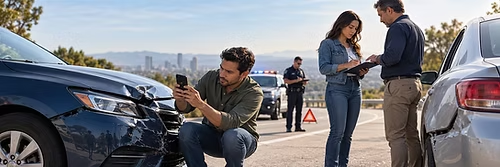
Documenting the scene of a car accident with photos and videos is one of the best ways to protect your rights. Evidence disappears quickly: the tow truck takes away the vehicles, the rain washes away the marks, and the witnesses leave.
With your phone, take photos of:
- The damages of all vehicles, close up and from afar.
- The final position of the cars before moving them, if it is safe to do so.
- The license plates of all vehicles involved.
- Brake marks, broken glass, and parts on the pavement.
- Traffic lights, stop signs, speed limits, and the condition of the street.
- Your visible injuries, the same day and in the following days.
- Nearby security cameras (businesses, gas stations), to request the video soon.
Later, as soon as you can, write or record a voice note with what you remember: where you were going, the time, the weather, and what the other driver did. Your memory today is worth more than in six months.
Why should you go to the doctor even if you feel well?
Early medical attention after a car accident protects your health and your claim at the same time. Adrenaline can mask the pain for hours, and injuries such as whiplash or a concussion can sometimes manifest one or two days later.
If you are not taken by ambulance, go to the emergency room, to an immediate care clinic, or to your doctor within the first 72 hours. Tell the doctor that you were in a car accident and describe every hurt, even if it seems small. Then follow the complete treatment. The gaps of weeks without treatment are the favorite argument of insurance companies to say that your injuries do not come from the crash.
| Key data: In 2023, 40,901 people died in traffic accidents in the United States and nearly 2.44 million were injured.Source: NHTSA, 2024. |
At the law firm of Christopher Pugh, health comes first. Part of his work in personal injury and motor vehicle accident cases is connecting clients with the right medical specialists in Georgia to document their injuries from the start.
How to obtain the police report of the accident in Georgia?
The police report of an accident in Georgia (Georgia Motor Vehicle Crash Report) summarizes the facts, the data of the drivers, the witnesses, and sometimes the officer’s opinion on who caused the crash. Your insurer and the other driver’s will ask for it.
- Ask for the report number at the scene and the name of the agency that responded.
- Wait a few business days. Reports are usually available within 3 to 5 business days after the crash, although it may take longer.
- Request it from the police agency that responded (for example, Norcross or Gwinnett County) or online at the BuyCrash portal, selecting Georgia and the corresponding agency.
- Check that the data is correct. If there is an error in your name, your policy, or the description of the crash, request a correction or an additional report.
If the police did not go to the scene and there were injuries or significant damages, Georgia law requires that a written report be submitted within 10 days following. A lawyer can help you complete that step.
How to report the accident to your insurer?
Reporting the car accident to your insurance company soon is a condition of almost all policies in Georgia. Call or use your insurance app within the first 24 to 48 hours and provide only concrete facts: date, time, location, vehicles, police report number, and details of the other driver.
What does the insurance ask you when you are hit?
The insurance company will generally ask you for these details and documents. Having them ready speeds up your claim:
- Policy number and information of the driver and passengers.
- Date, time, place and a brief description of the accident.
- Police report number and agency.
- Information of the other driver and their insurance company.
- Photos of the damages and, if available, videos.
- Repair estimates and later, invoices and medical records.
Should you provide a recorded statement to the other insurer?
A recorded statement is a telephone interview that the adjuster from the other insurance company records for later use. You are not obligated to give it. The questions are designed to minimize your injuries or have you accept some of the blame. The wisest course is to say that you prefer to speak with a lawyer first. Do not sign broad medical authorizations that give access to your entire history.
What insurance coverage applies in Georgia?
Georgia is a fault liability state: the driver who causes the crash and their insurer pay for the damages. Every driver must have at least liability coverage of $25,000 per person and $50,000 per accident for injuries, and $25,000 for property damage. These limits run out quickly in a crash with serious injuries.
| Coverage | What it pays | When it helps you |
| Liability of the other driver | Your medical expenses, lost wages, pain and damages to the car | When the other driver caused the crash |
| Uninsured motorist or underinsured motorist (UM/UIM) | Your damages when the at-fault party has no insurance, has little insurance, or fled | Hit and run or accidents with uninsured drivers |
| Medical payments (MedPay) | Medical expenses up to a limit, regardless of fault | To cover emergencies and copays while the case is being resolved |
| Crash (collision) | Repair of your vehicle, minus the deductible | When you need to repair the car quickly |
| Workers’ compensation | Medical treatment and part of your salary | If the accident occurred while you were working |
Source: minimum insurance requirements of Georgia (Georgia Legal Aid) and The Law Offices of Christopher Pugh, LLC, 2026.
If you crashed while driving for work, for example making deliveries, in addition to the claim for the accident you may also be entitled to a claim for workers’ compensation. Christopher Pugh manages both areas, which helps coordinate the two claims without losing benefits.
What mistakes should you avoid after a car accident?
The mistakes after a car accident that cost victims the most money in Georgia are almost always the same. This table summarizes what to do and what to avoid.
| Do this | Avoid this |
| Call 911 and request the report number | Fix it “between you” without police or report |
| Go to the doctor within the first 72 hours | Wait to see if the pain “goes away” |
| Tell the facts concretely | Apologize or say it was your fault |
| Keep photos, receipts, and invoices | Repair the car before documenting the damages |
| Consult a lawyer before signing | Accept the first offer from the insurance company |
| Keep your social media private | Post photos or comments about the accident |
| Follow all medical treatment | Miss appointments or leave therapy halfway |
Why does it matter who was at fault?
The fault in an accident in Georgia is divided according to the modified comparative negligence rule (O.C.G.A. § 51-12-33). If you have less than 50% of the fault, you can recover reduced compensation based on your percentage; if you have 50% or more, you recover nothing. This is why a statement made at the scene or a recorded statement can cost you the entire claim.
What changed with the 2025 reform in Georgia?
The 2025 Georgia civil liability reform (SB 68), signed in April 2025, changed important rules for accident victims. Among them, it can now be presented as evidence whether you were wearing a seatbelt or not, and jurors can see what was actually paid for your medical bills, not just what was billed. In practice, buckling your seatbelt and keeping every bill and payment is more important than ever today.
What to do if the other driver does not have insurance or fled?
An accident with an uninsured driver or who flees (hit and run) in Georgia does not leave you without options. Call 911 immediately and note everything you remember: color, make, part of the plate, and where they went. Look for witnesses and nearby cameras.
If you have uninsured motorist (UM) coverage in your policy, you can claim it to cover your injuries. In Georgia, this coverage is included in many policies unless the policyholder rejects it in writing, so review your policy or ask for help interpreting it. Your insurer may require that the hit-and-run be reported to the police soon to accept the claim.
What happens if you don’t have paperwork, a license, or insurance?
Your immigration status does not take away your right to ask for help after a car accident or to claim compensation for your injuries in Georgia. Many people avoid calling the police out of fear, and that decision ultimately harms their case because there is no official report.
If you were driving without a license or without insurance, that can bring traffic consequences, but it does not automatically mean that the crash was your fault. If the other driver hit you, their insurance is still liable for your injuries. Before speaking with any insurer, consult a lawyer who can explain your risks and your rights in English.
What to do if you were a passenger or were in Uber or Lyft?
Injured passengers in a car accident in Georgia are almost never at fault for the crash, so they are usually entitled to claim against the insurance of the responsible driver, which can be from their own car, the other vehicle, or both. The steps are the same: call 911, ask for the details of all drivers, take photos, and see a doctor.
If you were on a trip with Uber or Lyft, also take screenshots of the ride in the app (time, route, and driver’s name) and report the accident within the app. Ride-sharing companies have commercial policies whose limits depend on whether the driver was waiting for a ride, on the way to pick you up, or with a passenger on board. Those rules are complex, and a lawyer can identify which policy applies to your case.
If the accident occurred with a delivery truck, a vehicle from a company, or a commercial truck, note the name of the company and the vehicle number. There may be more than one responsible party and more than one insurance policy.
Timeline: what to do after a car accident
This timeline summarizes what to do after a car accident in Georgia, from the moment of the crash to the following weeks.
| Moment | What to do |
| At the scene | Safety, 911, help the injured, exchange data, photos, witnesses, report number |
| First 24 hours | Medical review, notify your insurance, write down what you remember |
| First 72 hours | Return to the doctor if new symptoms appear, keep prescriptions and invoices |
| 3 to 10 days | Request the police report, check for errors, submit a written report if the police were not present |
| First weeks | Continue treatment, keep a symptom diary, consult a lawyer before signing |
| Up to 2 years | General deadline for filing a personal injury lawsuit in Georgia (O.C.G.A. § 9-3-33) |
When should you call a car accident lawyer?
Calling a car accident lawyer in Georgia is advisable when there are injuries, when the insurance company questions who was at fault, when the other driver is uninsured, or when you are offered a quick settlement. Once you sign, you cannot ask for more money even if your injury worsens.
In The Law Offices of Christopher Pugh, LLC you work directly with attorney Christopher Pugh from day one. The firm, based in Norcross, limits its case volume to provide personal attention, handles the paperwork and communication with insurers, and keeps you informed at every stage in clear language. Learn more about Christopher Pugh and his approach.
| Free consultation: you do not pay fees unless the firm obtains compensation for you.Source: The Law Offices of Christopher Pugh, LLC, 2026. |
Frequently asked questions about what to do after a car accident
What are the legal steps to take after a traffic accident?
In Georgia, you must stop, help the injured, notify the police if there are injuries or damages of $500 or more, exchange your name, address, registration, and license with the other driver, and report the accident to your insurer. You generally have 2 years to sue for injuries.
What does the insurance ask you when you are hit?
The insurance company usually asks for the date, time, and location of the accident, the police report number, the other driver’s information and their insurance, photos of the damages, and later medical records. The other driver’s insurance company may also ask you for a recorded statement, which you are not required to provide.
Do I have to call the police if the crash was minor?
In Georgia, you must notify the police immediately if someone was injured or died, or if the damage to a person’s property appears to be $500 or more. Today, almost any impact exceeds that figure, so it is safest to call.
What happens if the other driver is uninsured or flees?
You can claim on your own policy if you have uninsured motorist coverage (UM). In a hit-and-run crash, call 911, note everything you remember about the vehicle, and look for cameras or witnesses.
Can I call the police if I don’t have papers?
Yes. Asking for help after an accident and claiming compensation for your injuries are rights that do not depend on your immigration status. If you have questions about your situation, talk to a lawyer before making statements to insurers.
How much does it cost to consult a lawyer after a car accident?
The consultation with The Law Offices of Christopher Pugh, LLC is free and without obligation. The firm works on a contingency fee basis: you do not pay unless you recover.
Contact us
If you already know what to do after a car accident but need someone to deal with the insurance company for you, Christopher Pugh can help you. He will review your case at no charge, explain your options clearly, and assist you in receiving the medical attention you need in Norcross, Gwinnett, and all of Georgia.
- Phone: 678-404-5226
- Email: info@chrispughlaw.com
- Office: 5815 Live Oak Pkwy, Suite 2H, Norcross, GA 30093
- Hours: Monday to Friday, from 9:00 a.m. to 5:30 p.m. (Eastern Time)
Contact us today for a free consultation. We do not charge unless you recover.
This article is informational and does not constitute legal advice. Each case is different. Consult an attorney about your particular situation.